How Traditional ATS Platforms Fail Modern Recruiters (And What AI Fixes)
Legacy ATS tools were built for compliance, not candidates. Here's where they break down - and how AI-native platforms are changing the game for modern recruiting teams.
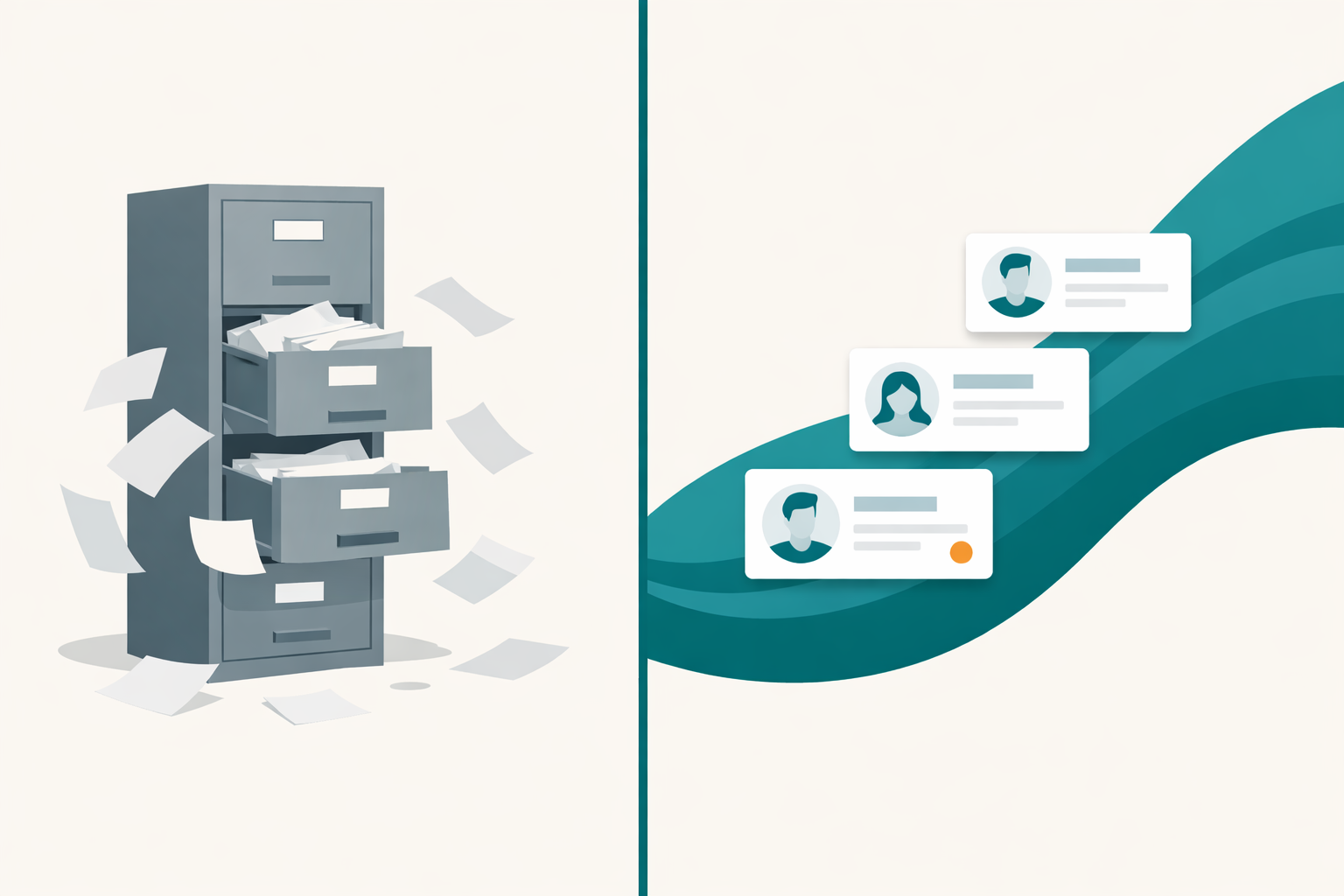
Nobody becomes a recruiter because they love babysitting databases.
But that's what a lot of "modern" Applicant Tracking Systems amount to: digital filing cabinets with a dated interface. They store resumes. They track stages. And they leave everything else - finding, engaging, and closing good people - entirely up to you.
Meanwhile, candidate expectations keep rising. Hiring volume keeps growing. Stakeholders keep asking for updates.
This gap is exactly what we're building Itrinova to close.
Where traditional ATS platforms fall short
Built for compliance, not candidates
Most legacy systems were designed to help HR stay organized and check regulatory boxes. Not to create a good candidate experience.
The result: long forms that make people re-enter information already on their resume. Clunky mobile experiences. Radio silence for weeks because there's no built-in way to keep applicants informed.
That's not just annoying. It damages your employer brand. Qualified candidates abandon applications halfway through.
Keyword matching instead of real talent discovery
Traditional screening lives and dies by keywords. If someone's resume doesn't use the exact phrases from your job description, they might never surface. Even if they're qualified.
What that means in practice: good candidates get filtered out because they described their experience differently. Adjacent skills are invisible. People with non-traditional backgrounds get buried because the system only recognizes a narrow set of terms.
You end up digging through LinkedIn anyway, looking for candidates your own ATS couldn't find.
Rigid workflows that create busywork
Legacy tools often enforce one linear pipeline: Apply, Screen, Interview, Offer. Same for every role, every region, every hiring manager.
That sounds organized. In reality, recruiters hack around it with spreadsheets. Hiring managers ignore the system and ping you on Slack instead. You spend more time updating stages than talking to candidates.
A lot of recruiters have basically traded one kind of busywork (paper forms) for another (data entry and clicking through rigid interfaces).
Data lives in silos
Modern recruiting uses a stack: sourcing tools, CRMs, assessments, scheduling apps, HRIS, background checks. But legacy ATS platforms often don't connect well with any of it.
You end up copying and pasting between systems. You can't get a unified view of your pipeline, source quality, or time-to-hire without exporting everything into spreadsheets.
Your data exists. It's just scattered and stale by the time you can use it.
Weak analytics
Older systems give you basic reports: applicant counts, stage breakdowns, maybe time-to-fill. But recruiting leaders today need more: real-time funnel visibility, DEI tracking, source quality (not just source volume).
Most legacy tools don't deliver that. Teams export to BI tools and make do.
What AI actually fixes
AI isn't just faster resume parsing. AI-native platforms, especially agentic ones, change who does the work.
Instead of you orchestrating every small step, you tell the system what outcome you want: "Hire 5 SDRs in Berlin in 45 days." AI agents handle more of the execution, with you supervising.
Here's how that maps to the problems above.
From clunky portals to an always-on concierge
AI-powered systems can answer candidate questions any time, auto-update people on their status, send prep materials before interviews, and nudge applicants who might be losing interest.
Candidates feel guided instead of ghosted. Without you writing every email.
From keyword filters to actual matching
AI can look beyond exact keyword matches. It can analyze skills (including adjacent ones), career trajectory, past hiring patterns, and engagement signals.
Instead of "does this resume contain these words," an AI ATS can tell you: "here are the 12 best-fit candidates, ranked by predicted success and likelihood to accept."
That means finding hidden talent in your existing database. Re-engaging strong runners-up automatically. Spending your time on evaluation instead of manual search.
From rigid workflows to adaptive processes
Traditional automation follows simple rules: if X, then Y. Agentic AI understands a goal and chooses actions to get there.
In practice, agents can build and adjust workflows based on role, location, and seniority. They can prioritize which reqs need attention. They can chase hiring managers for feedback. They can reschedule interviews when conflicts pop up and flag bottlenecks before you notice them.
You still make the decisions. Agents handle the coordination.
From data silos to real-time insight
AI platforms tend to be built with open APIs and analytics-first architecture. Combined with AI, they can pull data from across your stack and generate live dashboards for pipeline health, DEI metrics, and time-to-hire.
They can also recommend specific actions: "double down on this job board; it drives faster hires for sales roles."
You stop guessing and start running your function like a revenue team: experiments, cohorts, continuous optimization.
From admin-heavy to human-first
The consistent benefits teams report: efficiency, better candidate experience, data-driven decisions, less manual bias.
Done responsibly, that means less time scheduling and copy-pasting. More time advising hiring managers and closing candidates. More consistent evaluations. The ability to fairly consider more people, instead of just the first batch you have time to review.
AI isn't automatically fair, though. There are already lawsuits over hiring tools that discriminate when they're trained or deployed badly. Any serious AI ATS needs transparency, audits, and human-in-the-loop controls from day one.
How Itrinova approaches this differently
Itrinova is built for how recruiting actually works now. Not how it worked when the big ATS vendors designed their systems two decades ago.
Agentic at the core. This isn't AI bolted onto an old system. It's a network of recruiting agents (for sourcing, qualification, scheduling, follow-up) that work together to push each req toward your goal.
Goal-based workflows. You tell the system what you're trying to achieve: "Fill this role in 30 days with at least 3 diverse finalists." Agents figure out how to orchestrate the work. You stay in control of key decisions.
Human-first experience. Candidates get fast, clear communication. Recruiters get fewer clicks and more context. Hiring managers get actionable shortlists, not raw applicant dumps.
Built-in compliance and control. Itrinova is designed with auditability, fairness checks, and configurable guardrails. So you can adopt AI confidently as regulations tighten.
What's next
If your ATS feels more like a history project than a hiring engine, you're not imagining it. The gap between what modern recruiting demands and what legacy systems can deliver keeps getting wider.
AI, especially agentic AI, is the turning point: less admin, more strategy. Less keyword bingo, more real talent discovery. Less ghosting, more candidate advocacy.
If you're ready to see what an ATS can do when it actually thinks like a recruiting partner instead of a filing cabinet, now's a good time to find out.
Get Lia on your team and leave legacy ATS behind.
Ready to transform your recruiting?
Get Lia on your team and start hiring smarter.